
6 Best Markers for Anchor Charts for Teachers
Mr. Sketch Scented Markers are the top pick for most buyers seeking the best markers for anchor charts. Their broad tips and bold colors make large classroom letters easy to read from several feet away. These scented markers also offer a fun detail for teachers who want art supplies that feel less ordinary. The main tradeoff is the fragrance, which may bother students or teachers who prefer unscented supplies.
This guide is for teachers, homeschool families, and anyone making posters, classroom routines, or visual lesson aids. Tip width and color coverage matter most when choosing markers for anchor charts. Wide tips fill large letters faster, while strong coverage keeps colors visible on white or colored paper. Ink odor, drying speed, and the number of colors also deserve attention. The 6 picks below are ranked with reasons and honest drawbacks for each.
Quick Comparison
| # | Product | Best For | Price | |
|---|---|---|---|---|
| 1 | Mr. Sketch Scented Markers | Scented classroom art projects | $11.99 | View → |
| 2 | Sharpie Flip Chart Markers, Bullet Tip | Flip chart presentations | $6.02 | View → |
| 3 | Sharpie Permanent Chisel Tip Marker Set | Bold permanent lettering | $7.82 | View → |
| 4 | Coogert Jumbo Permanent Acrylic Paint Markers | Large outdoor craft signs | $15.99 | View → |
| 5 | Mr. Sketch Scented Washable Markers | Washable kids’ coloring | $21.67 | View → |
| 6 | Mr. Sketch Scented Stix Markers | Scented no-mess coloring fun | $6.50 | View → |
6 best markers for anchor charts, ranked
This list is ranked from sixth place down to the top pick, so you can compare each marker at a glance.
6. Mr. Sketch Scented Stix Markers

Best for: Kids’ fine-line coloring and crafts
Mr. Sketch Scented Stix Markers provide 10 fine-tip markers for coloring, drawing, school projects, and crafts. The slim cylinder is easy for small hands to hold, while the narrow tips suit outlines, lettering, details, and controlled lines. At $6.50, this set offers a low-cost way to add scented color to creative activities.
The main draw is the mix of bright shades and recognizable scents. The set includes Watermelon, Cherry, Orange, Banana, Mint, Fruit Punch, Blueberry, Grape, Cinnamon, and Licorice. Each scent gives the markers a playful sensory feature, although scent preferences will vary from child to child. The markers are AP certified and labeled safe for children over age 3, which makes them a reasonable choice for supervised home, classroom, or craft use. Their fine points favor detail work rather than filling large areas quickly.
Pros
- Ten different scents and colors give children more variety for coloring and crafts.
- Fine tips create cleaner outlines, small details, and handwritten designs.
- AP certification and the over-3 age guidance support age-appropriate use.
Cons
- Fine tips cover large coloring areas slowly compared with broad-tip markers.
- The scent selection is fixed, so children who dislike licorice, cinnamon, or strong fruity smells may not enjoy every marker.
5. Mr. Sketch Scented Washable Markers

Best for: Classroom art carts and craft tables
Mr. Sketch Scented Washable Markers come in a 36-count class pack with chisel tips and assorted bold colors. The large cylinder gives children a steadier grip than a slim marker, especially during longer coloring sessions. They are labeled safe for children over age 3 and carry AP certification. At $21.67, the set costs about 60 cents per marker.
The main draw is the scent variety. Kids get 12 options, including raspberry, watermelon, cherry, orange, banana, mint, apple, fruit punch, blueberry, grape, cinnamon, and licorice. Each scent adds a sensory detail to drawing, while the chisel tip supports both wide strokes and narrower edges. The washable ink helps reduce stress after spills on clothing or other washable surfaces, though cleanup still depends on the material and how quickly the mark is treated. This set fits group projects well, since 36 markers provide enough color choices for several children to share.
Pros
- 36 markers provide a useful supply for classrooms, siblings, or group crafts.
- Twelve scents give children more variety than standard unscented marker sets.
- Washable ink can make accidental marks easier to handle.
Cons
- Strong scents may bother children who are sensitive to fragrance.
- Chisel tips are less suitable for tiny details than fine-point markers.
4. Coogert Jumbo Permanent Acrylic Paint Markers
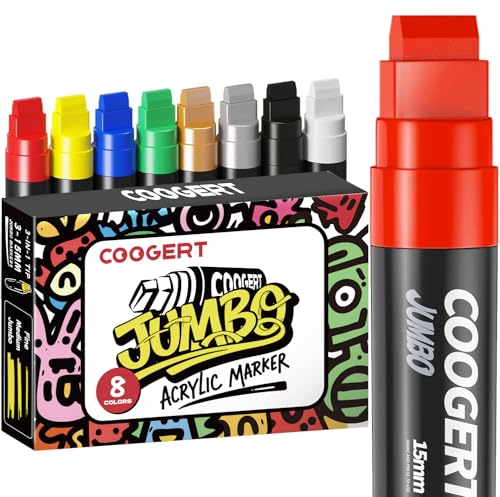
Best for: Bold classroom signs and posters
The Coogert set includes eight permanent acrylic paint markers with wide 15mm tips. Their jumbo size suits large lettering, banner work, poster boards, and simple graffiti-style designs. At $15.99, the set offers an affordable way to cover big areas without buying separate paint bottles and brushes. The markers are aimed at bold marks rather than fine illustration.
The paint can be used on canvas, fabric, wood, cardboard, rocks, glass, plastic, metal, windows, and car surfaces. That range makes the set useful for classroom anchor charts, event signs, window art, and craft projects. Permanent ink can help finished designs stay in place, but it may also stain surfaces or clothing, so test an inconspicuous area first. The 15mm tips should create strong, visible lines, although they will not replace narrow markers for outlines or small lettering.
Pros
- Eight colors provide a basic palette for signs, banners, and poster designs.
- A 15mm tip covers large letters and broad areas faster than fine markers.
- Works across many surfaces, including canvas, wood, glass, fabric, and plastic.
Cons
- The wide tip limits detail work, thin outlines, and small text.
- Permanent paint can be difficult to remove from clothing, furniture, or finished surfaces.
3. Sharpie Permanent Chisel Tip Marker Set

Best for: Colorful classroom and craft labeling
This 8-count Sharpie set uses permanent ink on paper, plastic, metal, wood, and many other common surfaces. The assortment includes black, blue, turquoise, green, lime, orange, red, and purple, giving you more range than a basic black-and-red pack. At $7.82, it offers a low-cost option for signs, storage labels, poster work, school projects, and home organization.
The chisel tip is the main practical advantage. Its broad edge covers larger areas, while the angled point can create narrower lines for lettering and outlines. The ink dries quickly, resists water, and is designed to resist fading over time. The markers also carry AP certification. That makes them suitable for many classroom and office projects, although permanent ink needs careful handling around clothing, finished furniture, and other surfaces you do not want marked. The set gives you eight colors in one purchase, but it does not include a fine-tip marker for small writing or detailed illustrations.
Pros
- Permanent ink works on paper, plastic, metal, wood, and other surfaces.
- Eight assorted colors support signs, labels, posters, and craft projects.
- Quick-drying ink resists water and fading after it dries.
Cons
- Chisel tips are less precise than fine tips for tiny lettering and detailed drawings.
- Permanent ink can be difficult to remove from clothing, furniture, or other unwanted surfaces.
2. Sharpie Flip Chart Markers, Bullet Tip

Best for: Teachers and office presentation teams
Sharpie Flip Chart Markers come in an eight-count pack of assorted colors for classroom lessons, meetings, and poster-sized notes. Each marker uses a bullet tip, which suits broad headings, lists, and diagrams better than detailed writing. The water-based ink is made for flip chart paper and is designed to resist bleeding through the sheet. At $6.02, the pack offers a practical supply for shared office or classroom use.
The strongest features focus on presentation comfort. The colors are designed to remain visible from a distance, helping people read notes from the back of a room. The low-odor formula should feel more comfortable during longer sessions than strong solvent-based markers. Sharpie also designed the tips to reduce the squeak that some markers make on paper. That detail may matter in quiet classrooms or meeting rooms. Still, these are presentation markers, not an all-purpose art set. The bullet tips may feel too broad for small lettering, and the product description does not specify the exact colors included.
Pros
- Eight assorted colors support color-coded notes, headings, and diagrams.
- Water-based ink is designed to limit bleed-through on flip chart paper.
- Low-odor ink and squeak-reducing tips suit classrooms and shared offices.
Cons
- Bullet tips are less suitable for fine details or very small writing.
- The markers are designed for flip chart paper, so buyers needing broad surface compatibility may need another set.
1. Mr. Sketch Scented Markers

Best for: Kids’ coloring and school craft projects
Mr. Sketch Scented Markers come in a 22-count set with assorted colors, chisel tips, and scented ink. The broad cylinder gives younger children a steadier grip than slim pens. Chisel tips can make both wide strokes and narrower lines, so kids can color large areas or add simple details. At $11.99, the set offers a sizable color range for classroom activities, drawing, and at-home crafts.
The scented ink is the main feature that separates these markers from standard classroom sets. Different scents can add another sensory element to coloring, though scent preferences vary from child to child. The ink is certified non-toxic, and the markers are AP certified for children over age 3. That makes them suitable for school and home use when children follow normal marker safety rules. The product details do not list marker dimensions or ink life, so buyers should not expect a specific usage duration. Scented ink may also be less suitable for children who are sensitive to strong smells.
Pros
- Includes 22 assorted colors, giving children more choices for drawing and coloring.
- Chisel tips support broad fills and narrower marks in one marker.
- Large barrels are easier for small hands to hold than slim markers.
Cons
- Scented ink can bother children who dislike strong or mixed smells.
- The set is intended for children over age 3, so it is not suitable for toddlers.
Buying Guide
The most important factor is ink visibility without bleed-through. Anchor charts often use thin paper, so choose markers that produce dark, readable lines while staying legible from 6 to 10 feet away.
- Ink Type: Choose water-based, low-odor ink for classrooms and shared spaces. Avoid alcohol markers unless the chart uses thick poster paper.
- Tip Shape: Select chisel tips from 3 to 6 millimeters. They create broad headings and narrow lines without requiring multiple marker sizes.
- Color Contrast: Pick black, navy, dark green, or dark purple for main text. Reserve bright colors for accents, since yellow and light orange can disappear from a few feet away.
- Drying and Smear Resistance: Look for ink that dries within 30 to 60 seconds on chart paper. Test one mark before stacking or transporting finished charts.
- Pack Size and Cost: A 10- to 12-count pack covers most classroom needs. Prices usually range from $8 to $20, and replaceable or individually sold markers can reduce waste.
If you cannot have everything, prioritize dark, bleed-resistant ink because readable text matters more than color variety or specialized tips.
Frequently Asked Questions
How do I choose the best markers for anchor charts?
Choose the best markers for anchor charts by prioritizing bold, low-odor ink, a broad tip, and paper-safe performance. Water-based markers usually work well in classrooms because they produce less odor and clean from hands more easily than permanent ink. Look for chisel tips around 3–5 mm for headings and smaller details.
What marker tip is best for anchor charts?
The best marker tip for anchor charts is a chisel tip because it creates thick headings, medium labels, and thin lines with one marker. A 3–5 mm chisel point gives useful control on standard poster paper. Bullet points look clearer when you turn the tip instead of pressing harder.
Can washable markers work for anchor charts?
Yes, washable markers can work for anchor charts when you want low odor and easy cleanup, but they may look less saturated on glossy paper. Choose a set labeled washable and test one corner before writing. Broad tips, such as 4 mm, help text remain readable from several feet away.
Are permanent markers safe for anchor charts?
Permanent markers are not the safest choice for most anchor charts because ink can bleed through thin paper and create strong odors. Use them only on thick, nonporous surfaces with good airflow. A water-based alternative is better for classroom charts, especially when children help write.
Conclusion
Mr. Sketch Scented Markers are the top pick for teachers who want bold, easy-to-read anchor charts with a little extra sensory appeal. If your priority is low-odor classroom use, choose a washable, unscented marker set instead, especially for small rooms or students sensitive to fragrance. Before buying, double-check the marker size, tip style, surface compatibility, package quantity, and current price, since listings can vary by seller and color count. For most classrooms, that means clear lettering, easy storage, and enough colors for headings, labels, and examples. Choose the option that fits your chart paper and classroom rules, then keep spare black markers nearby for quick touch-ups throughout the year.