
7 Best Litmus Paper for Home Science Tests
For most buyers, the best litmus paper choice is pH Test Strips, 240 Strips with Storage Case. This pH testing kit earns the top spot because its 240-strip supply and included case offer practical value for frequent checks. The strips suit quick color-based pH readings around the home, classroom, aquarium, garden, or pool. The case also keeps unused strips together between tests.
This guide is for anyone who needs simple pH checks without buying a meter. The main factors are test range, strip size, color-chart readability, and storage quality. A broad range works with more liquids, while larger strips and clear color blocks can make results easier to compare. The seven picks below are ranked with specific reasons and honest drawbacks for each, so you can match the paper to your testing needs and budget.
Quick Comparison
| # | Product | Best For | Price | |
|---|---|---|---|---|
| 1 | pH Test Strips, 240 Strips with Storage Case | Pool owners needing bulk strips | $3.99 | View → |
| 2 | Litmus Paper Acid/Base Test Strips, 100 Each | Students learning acid-base reactions | $11.89 | View → |
| 3 | Bartovation Litmus Test Paper Combo Pack | Households testing multiple liquids | $11.89 | View → |
| 4 | pH Test Strips, 2-Pack | Travelers needing compact pH testing | $3.99 | View → |
| 5 | JNW Direct Urine and Saliva pH Test Strips | Wellness users tracking body pH | $8.99 | View → |
| 6 | Handepo pH Test Strips 1-14 | Aquarium keepers checking broad pH | $29.99 | View → |
| 7 | Bartovation Neutral Litmus Test Paper Strips | Teachers demonstrating neutral solutions | $6.89 | View → |
7 Best Litmus Paper Products
This list is ranked from seventh place down to the top litmus paper pick, making product comparisons easier.
7. Bartovation Neutral Litmus Test Paper Strips

Best for: Classroom acid-and-base demonstrations
Bartovation Neutral Litmus Test Paper Strips provide a quick way to tell if a liquid is acidic or basic. Each pre-cut strip measures 0.25 by 1.75 inches, giving enough surface area for dipping without taking up much storage space. The 100-pack costs $6.89, so it suits classrooms, home science activities, and occasional household checks.
The strips change red in acids and blue in bases. That simple color response makes them useful when you only need a basic classification, not an exact pH reading. They arrive in a splash-proof vial that helps protect the paper during storage and handling. The strips are ready to use, so there is no cutting or setup beyond exposing one strip at a time. Their narrow size also helps limit waste for small liquid samples. However, the color result gives a general acid-or-base indication, not a precise value or strength measurement.
Pros
- Includes 100 pre-cut strips for repeated experiments and checks.
- Red and blue results make acid-versus-base identification easy to read.
- Splash-proof vial helps shield the paper strips from accidental liquid exposure.
Cons
- Does not provide a numerical pH value for precise testing.
- Each 0.25-by-1.75-inch strip is small, which may be awkward for very shallow or large samples.
6. Handepo pH Test Strips 1-14

Best for: Frequent pH checks at home
Handepo’s kit contains 4,000 disposable pH strips, divided into 50 packs of 80 strips. Each strip uses color-changing indicator paper and covers pH 1 through 14 in whole-number steps. The included color chart runs from very acidic at 1 to neutral at 7 and very basic at 14. At $29.99, the price works out to about $0.0075 per strip, before shipping.
Use one strip per test. Place a drop of the sample on the paper with a clean tool, then compare the resulting color with the chart. Do not dip the strip into the container. The small packs are easy to store and carry for fieldwork, classes, or routine checks of water, soil, diet, and bodily fluids. Results appear quickly, but the one-point scale gives an approximate reading rather than laboratory precision. The strips may not respond reliably to very weak buffers or acid and alkaline solutions below 0.01% concentration. That restriction matters for diluted samples and specialized chemistry work.
Pros
- 4,000 strips provide a low per-test cost and many replacements.
- The pH 1-14 range covers acidic and basic samples.
- Individual packs make storage and transport more manageable.
Cons
- Whole-number color steps cannot provide readings such as pH 6.5.
- Samples below 0.01% concentration or very weak buffers may produce unreliable results.
5. JNW Direct Urine and Saliva pH Test Strips

Best for: Routine at-home urine pH checks
JNW Direct pH Test Strips provide 150 litmus paper strips for testing urine or saliva. The urine scale runs from pH 4.5 to 9.0, giving you a broad range for basic sample readings. To use them, dip a strip into the specimen, then compare its color with the chart printed on the bottle. At $8.99, the kit costs about six cents per strip before shipping.
The large strip count supports daily use for up to five months, depending on how often you test. An included eBook offers diet and alkaline-lifestyle information, which may help users organize a personal tracking routine. Still, these strips measure the pH of urine or saliva at one moment. They do not show your overall “body pH,” diagnose illness, or prove that specific foods changed your health. Results can also vary with hydration, meal timing, and other factors, so unusual readings should not replace medical advice.
Pros
- Includes 150 strips, enough for frequent testing over several months.
- Tests both urine and saliva with one kit.
- Bottle color chart makes basic result matching quick and simple.
Cons
- Color matching can be subjective, especially between nearby shades.
- The strips cannot diagnose health conditions or accurately measure whole-body pH.
4. pH Test Strips, 2-Pack

Best for: Quick household liquid checks
This $3.99 pack includes 160 universal pH strips across two packs, giving you about 80 strips per pack. Each strip uses filter paper and covers the full pH 1-14 range. That makes it suitable for checking acidic or alkaline liquids, including water, soap mixtures, rainwater, pet water, and some household solutions. The strips are small and light, so they are easy to store or carry in a kit.
The main advantage is speed. The color change appears within about five seconds, and you compare it with the included pH color chart. The strips can also support basic water quality, chemical, and soil checks, but dry materials cannot be tested directly. You must first create a liquid solution, then place a drop on the paper. Do not dip the strip into a container, since that can affect the reading. For quick screening, the two-pack quantity offers plenty of tests at a low price, but it is not a replacement for a laboratory meter or detailed analysis.
Pros
- Covers pH 1-14, so it can test both acidic and alkaline liquids.
- Provides 160 total strips for repeated checks.
- Produces a readable color change in about five seconds.
Cons
- Results depend on matching the strip color to the printed chart, which can make close readings difficult.
- Dry soil, powders, and other solids require mixing with liquid before testing, and the strip should not be immersed.
3. Bartovation Litmus Test Paper Combo Pack

Best for: Basic classroom and household checks
The Bartovation combo pack contains 200 total red and blue litmus strips in two portable vials. Each vial holds pre-cut pieces, so there is no need to cut paper before testing. The strips require no external reagents or added chemicals. At $11.89, this pack offers a simple way to check common solutions at home, in a classroom, or in a small lab kit.
The red and blue papers provide two separate checks for the same solution. That extra test can help confirm whether the result points to an acidic or basic solution. No color chart is required for the intended use. Still, these strips only show if a solution falls above or below a certain pH level. They do not provide a precise pH number. Buyers who need numerical readings will need a pH meter or a more detailed test kit. The two-vial format also keeps the unused strips contained and portable between tests.
Pros
- Includes 200 total pre-cut strips for repeated checks.
- Two colors allow a second test to confirm the result.
- Needs no added reagents or external chemicals.
Cons
- Does not provide a precise pH value.
- Testing with two strip types takes more steps than using one indicator.
2. Litmus Paper Acid/Base Test Strips, 100 Each

Best for: Classroom acid-base demonstrations
This classroom-size pack contains 200 paper test strips, with 100 red and 100 blue pieces. Dip a strip into a liquid or solution, then read the color change. Red paper turns blue in alkaline conditions, while blue paper turns red in acidic conditions. The two-color setup offers a simple way to check acid versus base without electronic equipment. At $11.89, it provides a large supply for lessons, home experiments, or basic lab activities.
The main strength is its straightforward format. The strips are compact, portable, and easy to store in a drawer, kit, or field bag. They can support demonstrations and some checks of liquids, soil solutions, and certain gases. However, the product description does not explain a gas-testing method or specify strip dimensions. This is litmus paper, not a full-range pH kit. It shows if a sample is acidic or alkaline, but it does not provide a numerical pH reading. A color chart is not included, so users must judge the red-to-blue or blue-to-red change.
Pros
- Includes 100 red and 100 blue strips for repeated testing.
- Requires no meter, batteries, or mixing process.
- Compact paper strips suit classrooms, labs, and field kits.
Cons
- Does not show an exact numerical pH value.
- No color chart or detailed gas-testing instructions are included.
1. pH Test Strips, 240 Strips with Storage Case
Best for: People checking several household liquids
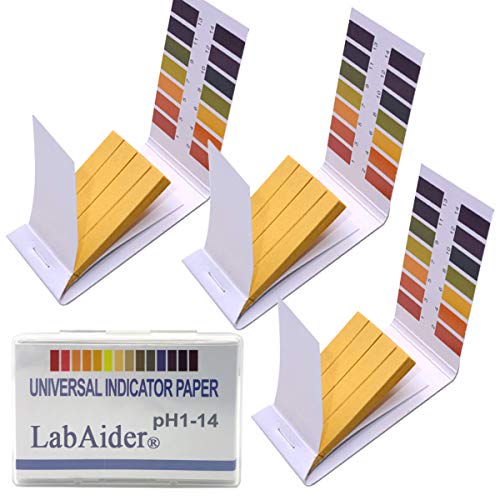
This set includes 240 paper pH strips across three packs, plus a storage case. Each strip measures 45mm by 7mm and covers the pH 1-14 range. That broad scale suits quick checks of water, soil, soap, lemon juice, milk, liquid detergent, saliva, urine, sweat, pet food, and similar samples. At $3.99, it offers a large supply for occasional household use.
To use one, place it against the sample, then compare the color change with the included chart within about 15 seconds. Lower numbers indicate stronger acidity, while higher numbers indicate stronger alkalinity. The three-pack format helps keep unused strips separated, and the case can reduce exposure to moisture between checks. These strips can support general pH monitoring, but they cannot confirm a medical condition or replace professional testing. Results also depend on how closely the strip color matches the chart.
Pros
- 240 strips provide many checks for $3.99.
- The pH 1-14 range covers acidic and alkaline samples.
- The storage case helps protect strips between uses.
Cons
- Color matching can be subjective, especially between nearby pH values.
- Results are approximate and unsuitable for medical diagnosis or precise laboratory work.
Buying Guide
The most important factor is the paper’s pH range, because the wrong type can give little useful information. Choose red or blue litmus for simple acid-versus-base checks, or universal strips covering pH 1–14 when you need a rough reading.
- Test range: Match the strip to your sample. Red and blue litmus only show acidic or alkaline conditions, while universal paper usually covers pH 1–14.
- Color scale: Choose a chart with clear color steps, ideally every 1 pH unit. A chart printed on the container is easier to use than a loose card.
- Strip size: Look for strips around 1 by 2 inches, or rolls you can cut to size. Wider strips are easier to handle with gloves or wet fingers.
- Pack count and storage: A 100-strip pack suits occasional household checks. Select sealed, moisture-resistant packaging, and keep unused strips dry and away from sunlight.
- Sample suitability: Confirm the paper works with your material. Pool water, soil slurry, soap solution, and aquarium water may need different testing methods or preparation steps.
If you cannot have everything, prioritize the correct pH range for the sample you plan to test.
Frequently Asked Questions
What is the best litmus paper for home use?
The best litmus paper for home use is a fresh, colorfast strip set with separate red and blue papers. Choose sealed packaging and clear color charts if included, especially for school, aquarium, or garden checks. Standard litmus paper usually identifies acid or alkaline conditions, but it does not provide an exact pH number.
How do litmus paper strips work?
Litmus paper works by changing color when its dye reacts with an acidic or alkaline solution. Blue paper turns red in acid, while red paper turns blue in alkaline liquid. A strip shows whether a solution is acidic or alkaline, and many products use separate strips for each test.
Can litmus paper measure exact pH?
Litmus paper cannot measure exact pH; it only indicates whether a liquid is acidic or alkaline. For a numerical reading, choose universal indicator paper labeled from pH 0 to 14, or use a digital pH meter. Litmus remains useful for quick checks, such as separating vinegar from a mild soap solution.
Are red or blue litmus papers better?
Neither is universally better; blue paper detects acids, while red paper detects alkaline solutions. Buying both gives broader coverage and reduces guesswork during testing. A two-color pack can check either condition, while using only one color may miss the result you need from a particular liquid.
Conclusion
pH Test Strips, 240 Strips with Storage Case is the top recommendation for households, aquarium owners, gardeners, and anyone who wants a large supply of simple pH checks in one organized package without buying a meter. If your priority is faster readings or tighter numerical control, pick a digital pH meter instead, since its screen provides a direct value rather than asking you to compare strip colors with a printed chart, especially when you need repeatable results. Before buying, double-check the strip size and test range, confirm compatibility with your water, soil, pool, aquarium, or other sample, verify the package contains the stated quantity, and compare the current price because listings and discounts can change.