
6 Best Engineering Notebook for Field Work
For most buyers, Engineering Notebook, Grid Graph Paper is the best engineering notebook because its gridded pages keep calculations, diagrams, and sketches organized in one place. This notebook format gives technical work a clear structure without forcing users into ruled lines or blank pages. It fits classroom assignments, design notes, lab records, and project planning, especially when accurate spacing matters.
This guide is for students, engineers, makers, and anyone who records measurements or develops technical ideas on paper. The key choices are page size, paper quality, and binding, since they affect writing space, ink bleed, portability, and how well the notebook stays open. A grid can also matter when you draw scaled diagrams or tables. The 6 picks below are ranked with clear reasons and honest drawbacks for each, so you can match the notebook to your work style and budget.
Quick Comparison
| # | Product | Best For | Price | |
|---|---|---|---|---|
| 1 | Engineering Notebook, Grid Graph Paper | Budget-Friendly Technical Sketching | $6.99 | View → |
| 2 | BookFactory Engineering Notebook | Durable Field Engineering Notes | $24.99 | View → |
| 3 | National Engineering and Science Quadrille Notebook | Science Class Calculations | $8.98 | View → |
| 4 | RETTACY Graph Grid Paper Notebook | Portable Graph Paper Planning | $7.99 | View → |
| 5 | Roaring Spring Graph Ruled Engineering Notebook | Classroom Engineering Assignments | $14.48 | View → |
| 6 | BookFactory Professional Engineering Notebook | Professional Project Documentation | $29.99 | View → |
6 best engineering notebook picks
These six engineering notebooks are ranked from sixth place down to the top pick.
6. BookFactory Professional Engineering Notebook

Best for: Lab records and engineering field notes
The BookFactory Professional Engineering Notebook is an 8” x 10” hardbound book made for technical records. It contains 96 pages with a 1/4-inch, or 6 mm, scientific grid. The black-and-burgundy imitation leather cover and stamped spine give it a formal look while protecting the pages during regular lab or office use. Its section-sewn binding lets the notebook lie flat, which helps when writing across the page or scanning notes.
The paper is FSC certified, acid-free, and 60 lb archival stock. That combination suits records that need to remain readable over time. The tamper-evident design adds another layer of control for documented work. Inside, a User Data page, Documentation Guidelines page, and Table of Contents help organize projects before the main notes begin. BookFactory produces this notebook in Ohio through a veteran-owned business. At $29.99, it targets buyers who need a structured record book rather than a casual writing pad.
Pros
- Flat-opening sewn binding makes two-page notes easier to write and scan.
- Acid-free, 60 lb archival paper supports long-term record storage.
- Built-in organization pages help track users, procedures, and sections.
Cons
- The 96-page capacity may feel limited for long projects or continuous lab logs.
- The fixed 1/4-inch grid is less suitable for plain prose, sketching large diagrams, or free-form notes.
5. Roaring Spring Graph Ruled Engineering Notebook

Best for: Engineering students and drafters
This 8.5-by-11-inch spiral notebook uses green-tinted, 20 lb engineering paper for calculations, diagrams, and technical notes. It contains 80 perforated sheets, with three-hole punching for binders or filing. The covered spiral helps keep the pages together, while the cover adds protection during transport and storage.
The layout is the main draw. Each sheet has a front frame with a 1/2-inch right margin, while the back includes an enclosed 5×5 grid. That structure gives math work and sketches a consistent space without relying on a separate ruler. The muted green paper may also reduce glare under bright lights compared with white sheets. Roaring Spring makes the notebook in Pennsylvania and has produced paper products for more than 100 years. At $14.48, it costs more than a basic spiral notebook, but the specialized format gives it a clear purpose.
Pros
- The 5×5 enclosed grid helps keep diagrams and calculations aligned.
- Green-tinted 20 lb paper can feel easier to read under harsh lighting.
- Perforated, three-hole-punched sheets are easy to remove and file.
Cons
- The green paper may not suit color-sensitive drawings, printing, or scanning.
- Removing pages reduces the notebook’s 80-sheet capacity over time.
4. RETTACY Graph Grid Paper Notebook

Best for: Students solving math and science problems
The RETTACY Graph Grid Paper Notebook provides a structured workspace in a compact A5 format, measuring 5.7 by 8.3 inches. It contains 192 pages of 100 GSM, acid-free paper, which should handle everyday pencil, ballpoint, and gel-pen work with less show-through than thinner notebook paper. The smooth leather hardcover adds protection for notes carried in a backpack or stored on a shelf.
Several practical details add value at the $7.99 price. The notebook opens 180 degrees for flatter two-page work, while an elastic band keeps it closed during transport. A pen holder keeps one writing tool nearby, and two ribbon bookmarks help track separate sections. An inner pocket stores loose papers, while the included sticky index tabs can mark formulas, assignments, or project notes. The grid layout fits graphing, calculations, diagrams, and organized lists. However, A5 pages offer less room than a full-size composition notebook.
Pros
- 192 pages provide substantial space for school notes, diagrams, and calculations.
- 100 GSM acid-free paper is thicker than basic copier-style notebook paper.
- The pen holder, two bookmarks, pocket, tabs, and elastic band improve organization.
Cons
- The 5.7-by-8.3-inch pages may feel cramped for large diagrams or lengthy equations.
- The listed features do not state the grid spacing, so buyers cannot confirm its fit for precise technical work.
3. National Engineering and Science Quadrille Notebook

Best for: Lab notes and technical sketches
The National Engineering and Science Notebook is an 11 x 8.5-inch spiral notebook made for technical writing, calculations, and diagrams. It contains 60 sheets of heavyweight white paper, with blue ruling and a rigid white wirebound cover. At $8.98, it offers a practical format for school labs, engineering classes, and project documentation.
Its main advantage is the mixed page layout. One side uses a 10-squares-per-inch grid, giving users tight control for graphs, schematics, and measured drawings. The opposite side uses college ruling with a margin, which suits written notes and lab observations. The listing also describes the notebook as having college ruling on the front and 10 x 10 quad ruling on the back, so the exact layout may vary by how the notebook is oriented. The unpunched paper keeps the pages intact, while the spiral binding allows the book to open flat. The white cover is functional, but it may show dirt faster than a darker design.
Pros
- The 10-squares-per-inch grid supports detailed diagrams and accurate graphs.
- College-ruled pages with a margin provide a familiar note-taking layout.
- Heavyweight, unpunched paper works well for organized lab records.
Cons
- The listing gives two descriptions of the page arrangement, so buyers may not know which side has each ruling.
- With only 60 sheets, frequent users may fill the notebook quickly.
2. BookFactory Engineering Notebook

Best for: Engineers keeping organized lab records
The BookFactory Engineering Notebook is a hardbound lab notebook with 96 pages of 0.25-inch grid paper. Its 8 x 10-inch format provides more writing area than a pocket notebook while remaining easy to store in a desk or lab drawer. The black imitation leather cover is stamped “ENGINEERING NOTEBOOK” and is designed for regular lab use. It is made in Ohio by a veteran-owned business.
Its sewn binding is a useful detail for technical work. The book can lie flat when open, which helps when writing measurements, copying notes, or scanning pages. Organization starts with a User Data page, Documentation Guidelines page, and Table of Contents. Those sections can help teams follow a consistent recordkeeping process, although they do not replace any company or regulatory requirements. At $24.99, it fits buyers who want a structured paper notebook rather than a basic spiral pad. The reorder SKU is LIRPE-096-SGR-A-LKT4.
Pros
- The 0.25-inch grid supports diagrams, measurements, tables, and technical sketches.
- Sewn binding lets the notebook stay open while you write or scan pages.
- Front-matter pages provide space for user details, documentation guidance, and contents tracking.
Cons
- The 96-page count may be limiting for long projects or daily records.
- The hardbound format offers less flexibility than a spiral notebook and may take more storage space.
1. Engineering Notebook, Grid Graph Paper
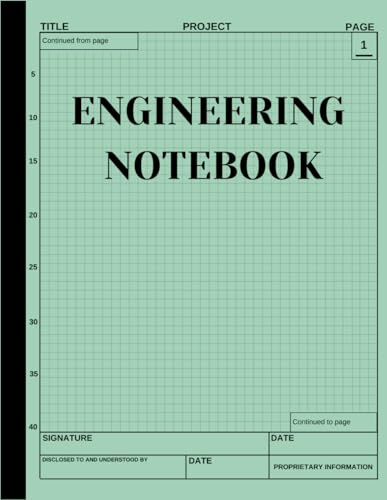
Best for: Students doing technical graph-paper work
This engineering notebook contains 100 pages of grid-format, quadrille graph paper for handwritten calculations, diagrams, tables, and technical sketches. The square grid can help keep lines, measurements, and equations aligned across each page. It suits math, physics, engineering, space science, architecture, design, and general classroom work. At $6.99, it targets buyers who need a dedicated paper notebook without paying for extra features.
The main appeal is its focused format. Plain notebook paper can make diagrams and plotted work harder to organize, while graph paper gives each page a built-in guide. The listing does not provide the notebook’s page dimensions, paper weight, binding type, cover material, or grid spacing. Those missing details matter if you need a specific drafting scale, a durable cover, or paper that handles markers and ink without showing through. The 100-page count offers a useful amount of writing space, but the notebook’s long-term durability cannot be judged from the available information.
Pros
- 100 pages provide substantial space for class notes, calculations, and diagrams.
- Quadrille grid lines help organize graphs, figures, and measured sketches.
- The technical format fits math, physics, engineering, architecture, and design work.
Cons
- The listing does not state the notebook size, so it is hard to confirm desk or bag fit.
- Paper weight, binding, cover material, and grid spacing are unspecified, which limits its use for demanding drafting or heavy ink work.
Buying Guide
The most important factor is the page layout. A 5 mm grid, numbered pages, and space for dates help you draw diagrams, track revisions, and find calculations later.
- Paper ruling: Choose a 5 mm or 1/4-inch grid for technical sketches. Dot-grid pages work well for lighter diagrams, while lined pages suit written lab notes.
- Paper weight: Look for paper between 90 and 120 gsm. It should handle pencil, ballpoint, and fine-tip ink without heavy show-through or tearing.
- Page organization: Select a notebook with at least 150 numbered pages, a contents page, and dedicated fields for the date, project name, and page title.
- Binding and cover: A sewn binding stays open more reliably than basic glue. Choose a hard cover for field work, or a flexible cover if the notebook must fit inside a tool bag.
- Size and price: A5 notebooks measure about 5.8 by 8.3 inches and travel easily. A4 or letter-size books provide more drawing space. Expect to pay about $10 to $30 for one durable notebook, or less when buying a three-pack.
If you cannot have everything, prioritize page layout, since clear organization protects the accuracy and usefulness of every entry.
Frequently Asked Questions
What is the best engineering notebook for design work?
The best engineering notebook for design work has numbered pages, a hard cover, and paper that resists ink bleed. Look for at least 100 pages, a table of contents, and space for project names, dates, sketches, calculations, and revision notes. A sewn or casebound spine also keeps pages open on a drafting desk.
What engineering notebook size is best for technical projects?
An A4 engineering notebook is the best size for most technical projects because it gives sketches and calculations more room than A5 paper. Its 210 by 297 millimeter pages fit common folders, while an A5 book, at 148 by 210 millimeters, works better for field notes and compact tool bags.
Can the best engineering notebook support formal design records?
Yes, the best engineering notebook can support formal design records when it uses permanent page numbering, dated entries, and clear correction practices. Use one line per change, draw a single line through errors, and add initials beside edits. A bound book with 80 to 200 pages creates a stable project record.
Are engineering notebooks waterproof?
Some engineering notebooks are waterproof, but most standard paper versions are not, so check the product description before buying. Waterproof models often use synthetic paper and sealed covers, while ordinary books may handle brief splashes only. For outdoor work, choose a notebook rated for wet conditions and pair it with a pencil or waterproof pen.
Conclusion
Engineering Notebook, Grid Graph Paper is the top recommendation for engineers, students, and technical planners who need a dependable page layout for sketches, calculations, measurements, and short project notes. If your priority is portability, archival paper, or a larger writing area instead, choose the competing notebook that matches that need, since grid spacing and cover design alone may not suit every workflow. Before buying, double-check the notebook’s finished size, grid compatibility with your preferred rulers or templates, page quantity, and current price, because listings can change and similar titles may describe different editions. A quick review of the product details can prevent an awkward fit, missing pages, or an unexpected cost after checkout.